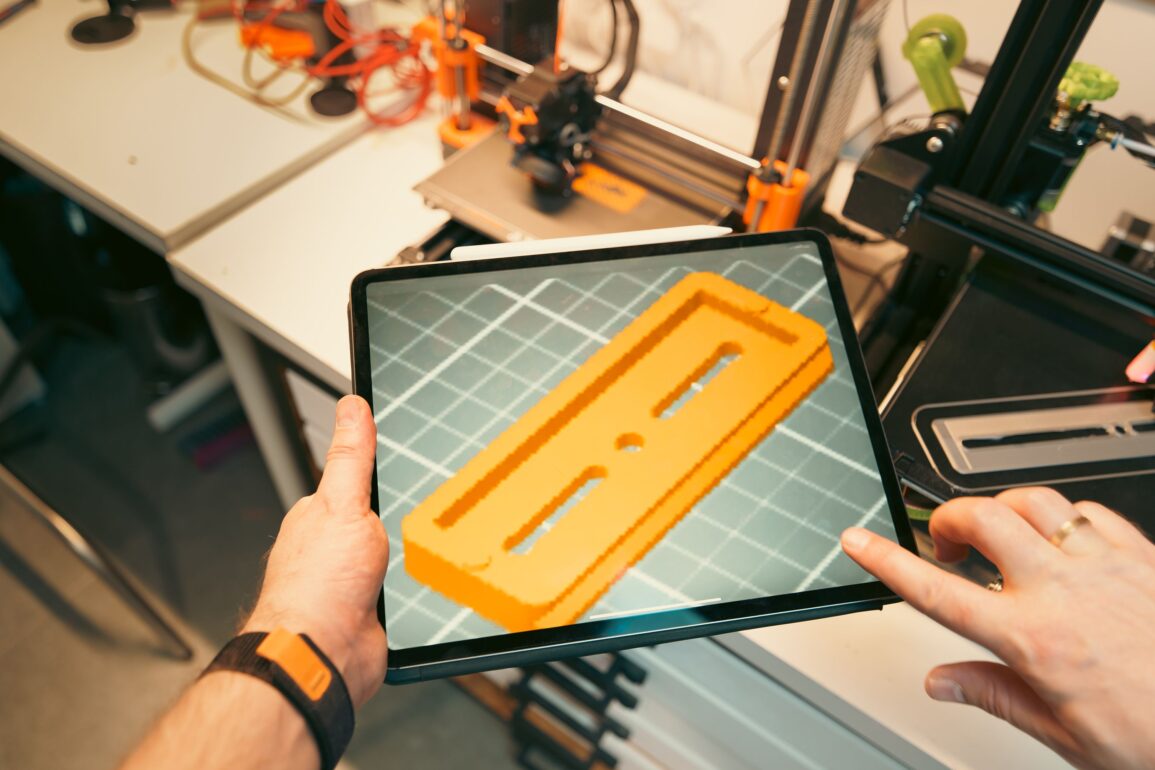

Testing an invention prototype is not one task. It is five separate questions, and answering them in the wrong order wastes money. Does it work, does it survive use, can a person use it without a manual, is it safe and compliant, and can it actually be made at volume. Most of these can now be answered on a virtual prototype, a CAD model and photorealistic renderings, long before anyone commits to a physical build. Sorting your testing into these five categories tells you what to check, in what sequence, and how much of it needs atoms instead of pixels.
1. Function: does the core idea do what it claims
Function testing asks the single question everything else depends on. If the mechanism does not do its job, no amount of durability or styling matters. A great deal of function testing happens in CAD today, where motion, clearances, and interference between parts are checked in a simulated assembly before a single component is cut. Kinematic simulation catches parts that collide, tolerances that stack up wrong, and movements that bind, all on screen. Physical function testing follows only for the specific behaviors a model cannot fully predict, such as fluid dynamics or material feel.
2. Durability: does it survive real use
A product that works once and fails on the hundredth cycle is not ready. Durability testing simulates the life of the product: repeated actuation, load, drop, temperature swings, and wear at contact points. Finite element analysis run on the CAD model predicts where stress concentrates and which features are likely to crack or deform under load, which lets a designer thicken a wall or add a rib before committing to tooling. Physical stress testing then confirms the prediction on the parts most likely to fail rather than on the whole assembly.
3. Usability: can a person figure it out
Usability is where inventors are least objective, because they already know how the product works. A fresh user does not. Ergonomic evaluation checks grip, reach, control placement, and whether the intended action is obvious without instruction. Photorealistic renderings and animation let test participants react to the product’s form and operation early, and virtual reality walkthroughs can put a product in someone’s hands, in a sense, before it physically exists. What matters is watching someone who has never seen it try to use it, and noting every hesitation.
4. Safety and compliance: does it meet the rules for its category
Safety is not optional and it is not a judgment call. Consumer products in the United States fall under standards enforced by the Consumer Product Safety Commission, whose regulations and mandatory standards are published at cpsc.gov. Children’s products, anything with a battery, and anything that heats, cuts, or contains small parts carry specific requirements. Checking the applicable CPSC standard early shapes the design, because a safety requirement discovered after tooling is an expensive redesign. Many compliance questions can be assessed against the CAD model and material choices before physical testing confirms them. For a category-by-category walkthrough of how these tests fit together, this overview of how to evaluate an invention prototype across the categories that matter is a useful companion.
5. Manufacturability: can it be made at volume and price
A prototype that only a skilled technician can assemble by hand is not a product, it is a demonstration. Manufacturability testing asks whether the design suits a real production process: injection molding, sheet metal, casting, or assembly. Design for manufacturing review, done on the CAD model, flags features that cannot be molded, undercuts that need expensive tooling, and part counts that could be consolidated. This category is where virtual testing saves the most money, because a manufacturability problem caught in CAD costs a design revision, while the same problem caught after tooling costs a new mold.
Why the order matters
Run these in sequence and each stage protects the next. There is no reason to durability test a mechanism whose function is not confirmed, or to tool a part whose manufacturability was never reviewed. The virtual-first approach compresses the early categories, because function, stress, ergonomics, and manufacturability can all be examined on a CAD model and renderings before any physical prototype is scoped. Physical builds are reserved for the specific unknowns a model cannot answer, which keeps the budget aimed at real questions.
This integrated way of working, keeping engineering, design, and testing on the same digital model, is what Enhance Innovations, a product development firm in Champlin, Minnesota, has done since 2010. The National Institute of Standards and Technology publishes engineering and measurement references at nist.gov that are worth consulting for the technical standards behind durability and materials testing, and the U.S. Small Business Administration at sba.gov offers guidance on validating a product before scaling production. This article is educational and is not engineering or legal advice; confirm the requirements specific to your product and category.